

There are endless reports on the state of the changing retail sector. WARC reports retail media is benefiting from increasing spend but warns we all need to get better at measuring the potential long term equity which will result. Expressions like ‘measurement stack’ are no doubt bouncing off the walls in retailer boardrooms.
For every retailer the pressure is on from every possible angle. For the charity retail sector, it is likely to be less ‘what is my measurement stack’ and more ‘did we hit our target for the week, month, quarter… have we raised enough? Can we keep providing the services we know are needed?’.
If you are a charity with high street retail presence, limited resources but a critically important message, every penny is going towards production of precious marketing and in store materials. The basic measurement of what keeps you going; cash in the tills and donations, are likely reducing on a backdrop of increased demand and pressure to deliver.
There are striking differences in how we treat charity retail as consumers and shoppers but even more so when it comes to the all important messaging to raise awareness, drive sales in those spaces, and land the donations every charity and hospice needs.
Messaging that has to work twice as hard
Yet how do we define the investment into the messaging which does more than simply point to a retail destination?
A recent podcast from the newly formed Charity Shop Chat1 looked at what this part of the retail sector which makes up some 11,000 shops on our high streets, could learn from shopper psychology. The episode which caught the attention of our ears featured Ella Baynes from Savvy Marketing’s Research and Insight team and their CEO Catherine Shuttleworth. Ella and Catherine shared a number of critical stats which are useful for every retailer but critical for the charity sector.
- Brands have less than 3 seconds to capture attention in store2
- Gen Z and Gen A are at the forefront of sustainable shopping and ‘pre-loved’ market
- Retail can be a third space – especially in the charity retail sector
Gen Z we know are a formidable force when it comes to shopping but what about Gen A? If we think that by 2030, the first born Gen Alphas will 20 years old. They were born in 2013. And have significant buying power. The way Gen A consumes and shop is being formed now. With the future of many charity shops rooted in the appeal of worthy cause and a circular economy, this is a generation worthy of attention.
Growing preferences
The growth of ‘peer to peer’ platforms like Vinted and Depop are however impacting charities. 19% of UK consumers surveyed by Mintel3 in October 2025 used Vinted. 35% of these consumers said they shopped for second hand or via peer to peer market places. Times are tight for both shoppers and retailers and 60% of consumers saying buying second hand really helps stretch their budget. Most shoppers who make a conscious choice to buy pre-loved stick to those buying habits when finances improve.
This points to an emerging view of consummation habits which the charity sector could and should leverage.
What messaging?
The Charity Shop Chat podcast reminded its listeners the conscious choice for some charities is not to overtly point out their reason for existence within stores. The reason may be charities feel this is too stressful, triggering or morbid. Is there a missing link which charity retailers are missing?
Charity shops are dealing with a trifactor of messaging for everyone who walks in. Knowing everyone who walks in is a potential donator of items or a shopper – or both they have a complex communication job on their hands. Charity store staff and volunteers need to communicate the charities aims, how and where to donate (and what’s accepted there) and what you can buy in seconds. And don’t forget about asking for Gift Aid! The 25% extra from the Government is essential for every registered charity so making the process of donating and recording data simple and fast is critical.


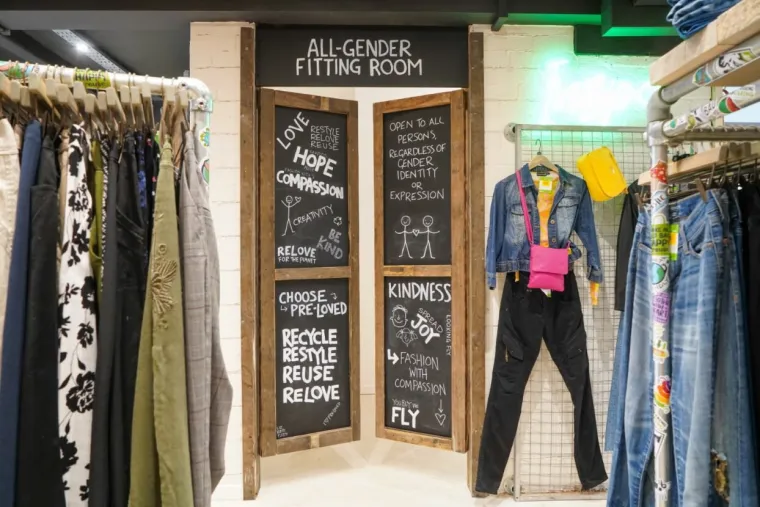

All marketing materials need to work hard in the charity sector. From the direct mail which lands at home to clear signage and POS in stores, all messaging needs to capture these critical factors to leverage positive reinforcement.
The Third Space
Charity retail spaces provide a unique community function. Charity shops are often the welcome space for everyone and anyone. By their very nature, they project care, compassion, humanity. This is potentially one of the only retail spaces where you can donate, buy or just find a friendly face when you need it.
As a result, the opportunity to link the work they do with the importance of the retail space they occupy and its reason for being there is even more important.
Understanding how a purchase and gift aid has a direct impact on the care and support the charity shop you have chosen to shop in is a very powerful thing. And whilst we may see this on direct mail as a message from some organisations, its not always executed in store. Charity Shop Chat defined this as one of those unique, attention, persuasion conversion situations in retail where your purchase is directly linked to care and support of a stranger or a loved one.
With suggestions of how these spaces could be combined for community and social good, the podcast gave examples of combined coffee and shopping spaces, demonstrating ways to reimagine the retail formula for charities.
Take the consumer from sofa to store
Taking the consumer on a journey from sofa to store provides an opportunity to build messaging through thoughtful, considered prompts to encourage action.
Reflecting on the role experience in retail spaces, research by MESH4 suggests 28% of all experiences consumers have with brands come directly from retail. Over half of us (52%) have some sort of retail experience in the average week, increasing brand exposure by 1.9x. when we consider other brand exposures. This shows us the retail setting and experience is critical to how we engage with the brand, with the same research showing persuasive messages in retail outstripping other mass media we may encounter.
Smaller retail POS over delivers
This learning can really benefit the charity retail sector, particularly as retail messaging effectiveness when linked to smaller stores is more than doubled by delivering a greater ‘opportunity to see’ through POS. Smaller stores showed a 6.8% brand/message recall5 from POS in stores vs their larger counterparts (3.5% OTS).
With important and lifechanging messaging needing to reach the shoppers in charity retail settings this insight points to opportunities to communicate more with shoppers.
Investment is precious
Marketing spend for every organisation is carefully planned and allocated – and it needs to work twice as hard for this sector. It’s even more important to therefore ensure the supply chain partners charities work with are regularly reviewed, revised and regulated. When every penny counts, investing money intot the areas where consumers respond and react is imperative.
Even if the sophistication of a measurement stack isn’t possible, we find those who examine the long tail spend in marketing, particularly in print and marketing production, can find significant savings and efficiencies.
Review, revise, regulate
Simple to say and straightforward to do – and with ways to make the savings stick, every charity with retail feet on the street should consider what budget is hiding in plain sight in their marketing budgets, how they can unlock this.
Find out more about how we help retailers review, revise and regulate marketing procurement spend with a Contract Performance Review. A no cost, no obligation way to find out if your organisation is really receiving the value you deserve.
- Charity Shop Chat Podcast: What Charity Retail Can Learn from Shopper Psychology ↩︎
- Savvy Marketing Shopper Panel ↩︎
- Mintel. Peer to Peer Platforms, October 2025 ↩︎
- MESH SMG P2PI ↩︎
- Lumen, Co-op Media Network, In-store retail media attention study ↩︎
